What Safety Means to Me

I wrote this, originally, back in 2010, for the UK fanzine Journey
Planet and their issue focusing on sexual harassment. It seems germane
to the current discussions.

I don’t remember when I
learnt that my body was not mine alone. That knowledge, that I am partly
public, has been with me for years and years and years. I absorbed it
in the comments of family and friends on how pretty – or, more often
plain – I was. I drew it in from the pictures on the television, the
Slimcea girl who was showing herself to the world, perfected through
self-privation.; the Playtex girdle woman who knew that hours of
discomfort was better by far than being seen to be imperfect; the
Harmony girl on whose hair men always remarked. I knew it from my
mother’s comments on actresses and models and friends. My mother is a
kind woman, and her comments were seldom cutting, and yet I knew all the
same from her that X wasn’t as pretty as she might be, due to the size
of her hips, or that Y dressed badly for her shape. I knew it through
the girls at school who were harsh in their judgement of everything –
openly their enemies, privately, their friends, most privately of all,
perhaps, of themselves. I’m so fat, I’m so plain, my nose is all wrong,
I’m flat-chested, my boobs are too big. Not one of us was content with
herself and nor were we encouraged to be. We were female in public,
there to be seen and to remarked upon. Sometimes boys were remarked on
also – for size, for hair colour – but it was only certain boys, not all
boys. It was not all the time. There was no Slimcea boy, no girdle guy,
and the Old Spice man was an adventurous surfer. People did not touch
my brother in the same ways they tried to touch me, and they did not
caution him that his behaviour must be modulated at all times to avoid
the wrong kinds of attention from the opposite sex. Boys have powerful
impulses. You mustn’t lead them on. It was a double warning: my body was
not only mine, and it was up to me to police it at all times lest it
cause problems. We are taught, all of us, from early on, that the female
form is both desirable and dangerous. We are taught to feel ashamed of
it or awed, covetous or intimidated, despairing or resentful. Girls are
taught that it must be controlled and disciplined, pummelled and
starved, before it can become acceptable – ‘figure faults’ must be
corrected, different parts must be displayed or covered, stripped of
hair, dyed, strapped in, or out, or down. Yes, some of us opt out of
some or all of this. But whatever we do, there will likely be comments.

And
you’re wondering, out there, what all this has to do with anything,
you’re wondering, and maybe saying, ‘well, men have body image issues
too, and people yell things at them too’, and all that is true enough.
But what I’m saying is this: we are taught as a culture that women are
to be looked at, and both sides accept this. And this inevitably affects
the ways in which we behave to ourselves and to each other. The female
body is culturally packaged and sold back to us, not as it is – the
shape of a person – but as something separate, something at once less
and more, and it’s this attitude that leads to the Open Source Boob
Project nonsense of a year or so ago (the promoters of that seemed to
have forgotten that breasts come attached to people). Being female is an
action, in every moment and every space, it is loaded, immanent with
meaning, coded, complicated.

When I was nineteen, a man I knew
though fandom stalked me for about 6 months. I did not know it was
stalking, though I knew it was worrying and distressing and undesirable.
I didn’t know it wasn’t my fault. Some of that was down to
circumstances – stalking had not at the time been widely discussed and I
had no label for it. Part of it is down to my own education: I didn’t
know what to do with the situation, how to deal with it. I’m not sure I
told anyone, apart from my boyfriend of the time.

He blamed me
for it. I must have done something to make this happen. I spent 6 months
feeling scared and culpable, trying to avoid the stalker and
simultaneously feeling that I ought to be extra nice to him, because
somehow I had made him do this, I had brought this on myself, while all
the time inside me all I could hear was fear and revulsion and a desire
to get him as far from me as I could. Another young woman might have
reported him, made a fuss, made threats: I wasn’t that woman, I hadn’t
been told that was allowed.

I’m lucky: that man didn’t hurt me.
In the end, he found another young woman who was actually interested in
him and entered into a long relationship with her. But all these years
later, I wish that 19-year-old self had known she was allowed to make a
fuss, to summon college porters, to threaten him with the wrath of
college authorities. Because I didn‘t have to endure that, I didn’t have
to hide in my room like that for all that time, it had never been my
fault. He was attracted to me. I was not attracted to him. That should
have been the last of it. But my context – and that old boyfriend –
convicted me of being female in public, contributory in my own fate.

I was lucky.

I’m
not even sure I should write that, though my head is full of sentences
which start that way. I’m lucky, I’ve never been raped. But what about
the man – a different man, around that same time – who insisted on
spending the night in my room despite my protests, and on handling me
despite my protests, because he was unhappy and I owed him? What about
the man who verbally coerced me into sex? The man who forced me into his
car? The man – a complete stranger who openly groped my body in a con
lounge? The man who informed me I would be providing him with sex due to
my hair colour? What about all those men who looked and saw my shape or
my clothes, saw Woman, but not Person? Was it luck that meant none of
those situations got out of hand? Lots of time, no, it wasn’t, it was
other people – the good guys and gals of fandom who came over and
intervened, who protected and helped, who helped me when I didn’t know
how to help myself. Sometimes it was… I don’t know. Not luck, just a
sense that I had to get through this and out the other side.

Not
all the situations I’ve listed above happened within fandom, but all of
them happened. I’m not particularly pretty: I was just sometimes in the
wrong place. It’s a sad fact that most women have had brushes with this
kind of thing. Which is not to say that all men are bastards, all men
are abusers, all men are the enemy. Nothing is that simple. Nothing is
that easy.

And fandom can be extra-complicated, because it
constructs itself as a safe space in many ways. It’s often said that
fans include a fair number of people whose experience of wider society
has not always been kind, and who are perhaps thinner skinned or less
comfortable with some forms of socialisation. A lot of people expect to
be more readily accepted within fandom. (I’m not 100% sure that this is
true: fandom can look pretty unkind sometimes. But this is not the place
for yet another discussion of the Myth of Fannish Tolerance.) Fans can
be more touchy-feely with one another, they may dress a little (or a
lot) oddly. It can be hard to see where boundaries lie. It can be very
easy to cross those boundaries by accident. It happens. But there is a
huge difference between accident and intent. And that’s where the
difficulties arise. That’s when safety for one person becomes danger for
another.

If you dress like I do – I have done – then it will
draw attention of all kinds. I accept that (and the only time I resented
it involved a hotel employee who was hoping for a bribe). I accept that
if I wear a short skirt, someone may comment and the comment may not be
complimentary. I accept that I may be asked for contact or more. I
dress as I do because it’s how I am, who I am. And I accept the
consequences.

Up to a point, and here it is: it’s still my body,
my self. I’m still a person, under the clothes and the flesh. I have
the right to say no. I have the right to say no and walk away. I have
the right to say no and walk away and to have that respected. It was the
chant of the Reclaim the Night marches: Whatever I wear and wherever I
go, yes means yes and no means no. It ought to be easy.

It
isn’t, of course. People get confused, or resent what they see as
rejection. People misinterpret, they hope, they imagine. We all do it.
But the thing is that once that ‘no’ is established, that should be the
end of it. My reactions are my responsibility. Yours are yours. I didn’t
owe that young man who stalked me anything, but he didn’t understand
that, and for month on month, he made my life unsafe.

And it really is that simple. It’s okay to ask. But no is no, and that should get to be the end of it.

Endnote: I’m 50. I’m average looking. These days, I’m fairly sharp-tongued.
I’ve
yet to get through a single con without someone behaving
inappropriately to me. Touching, backing into corners, talking to my
(modest) cleavage, asking creepy questions, standing too close. I am, I
repeat, 50. I’ve been with the same man for nearly 26 years and we are
usually together at cons. And men go on doing this, sometimes in front
of him.

This is not how the world should be.

You can find more of this discussion by looking for the #sffragette hashtag on twitter
#Womentoread

So, yesterday I decided to indulge in another round of that intermittent habit, poking the internet with a stick, but starting a hashtag — #womentoread — over on Twitter. I asked people to recommend sff by women. The response was astonishing: I’d hoped that some of my friends would pick it up, but… One of the very first to do so was Seanan Mcguire (Thank you, Seanan!) and it just took off. All afternoon (my timezone) and well into the evening, people were naming their favourites, exchanging names and recommendations and ideas. It was huge fun and the enthusiasm and engagement and excitement was just wonderful. I am profoundly grateful to everyone who joined in and help this happen. Towards the end of the day (my time) writer Harry Connolly (gave me the idea of capitalising on all this momentum by linking it to a series of blogposts about specific women writers and post links to these pieces on twitter using the hashtag. (You can read Harry’s article here I’ve written about women writers whose work I love before, of course, but the problem has been that relatively few people saw them — mainly my existing social circle and readers. And that is a key issue for many women writers: underexposure. But the hashtag, as I said, has some momentum, so this seems like an opportunity to try and raise the profile of writing by women and to address that underexposure to some degree.
But why now, exactly. I’ve done something like this before (last year with the fantasy by women thing). That’s part of it. I am an activist to my bones: it’s coded into me to try and *do* something when I see an injustice. And I know far too many really great women writers who are underrated, under-reviewed, under-recognised. I see male writers praised for doing things in books which women did before them, which women are doing as well as them — but the women are ignored and sidelined. It is a fact that books by women are reviewed less frequently than books by men, and that prestigious review locales pay less attention to women than men.
This year’s review survey came out two days ago. During the day, my twitter feed was full of men — many of them high-profile and influential — decrying the under-representation of women writers in reviews (and I am very glad to see them recognising this and commenting on it) but immediately going back to talking about, promoting and praising works by other men. Last week, my friend and fellow writer Juliet E McKenna found ourselves in a major branch of a major UK book-chain in Oxford and noticed a promo table for fantasy. We’re both fantasy authors, we took a look. The theme was clearly ‘If you like George R R Martin, try this". It was a table about 4 foot x 4 foot square, piled high with fantasy. Great.
Except… all but three of the writers represented were men. And of the remaining 3 — the women — two were not epic fantasy writers but established Big Name Bestsellers — Stephenie Meyer and Suzanne Collins and the books by them on that table were both sf. That’s fine. I love sf by women. But those two books — The Host and The Hunger Games weren’t there because they were ‘like’ A Game of Thrones; they were there because they’re already bestsellers in a related field. The other women present was an epic fantasy author and a good one — Robin Hobb. Who has a gender-neutral name.
I’m not saying the men on that table aren’t good: there were some excellent books there, by excellent writers. There were also books by men I’ve never heard of, which are quite probably also excellent books. But the overall impression was ‘This is A Man’s World’. Jules and I started making a list of who was *not* on that table, of women who are epic fantasy writers and published in the UK.

Kate Elliott
Judith Tarr
Freda Warrington
Gail Z Martin
Trudy Canavan
Karen Miller/K E Mills
Glenda Larke
Cecilia Dart-Thornton
Gaie Sebold
Juliet E McKenna
Tanith Lee
Amanda Downum

That was in about a minute. Now, you can argue, very reasonably, that some of those women are out-of-print here (but you might like to think about how they came to fall out of print in this context, given that contracts depend on sales, sales depend on exposure — and women do not get the exposure).
A table that censored women from a genre.
A twitter feed that decried a wrong — and then went back to the male default.
I saw red. At some point on the 22nd April, I asked, rather wistfully, if we could declare the next day — yesterday — promote women writers day. I got two responses, both from women, saying, yes, lets, and so…
I did.

You can see some of the responses and recommendations here. You can find more by going to twitter and hunting for the hashtag #womentoread.

You can share the idea. You can write a review of a book by a woman. You can blog about a woman writer you admire. You can post a list of links to the websites of women writers you love. It doesn’t have to be ep;ic fantasy or even sff. It can be any genre. And then, please, go to twitter and tweet that link with the #womentoread hashtag. If you’re not on twitter, post the link here in the comments and I will tweet it for you.
This isn’t about me. I know how it can look, I’m a fantasy writer. But really, it isn’t. This is about all those fantastic women writers whose books I’ve treasured for years, about Tanith Lee and Evangeline Walton, Judith Tarr and Kate Elliott, Anne Gay, Storm Constantine, Sherwood Smith, Rumer Godden, Juliet McKenna, Barabar Michaels, Elizabeth Goudge, Liz WIlliams, Dion Fortune, Sheila Gilluly, R A McAvoy, Barbara Hambly, Leah Bobet, Sarah Monette, Justina Robson, Amanda Downum, Claudia J Edwards, Sharan Newman, Freda Warrington, Stephanie Saulter, Lisanne Norman, Jaine Fenn… I could go on and one and on. Some of those writers are long-established, some are out of print and out of contract, some are new, some are dead. But they are all great.
And me? Later today I’ll be blogging here and on my livejournal blog about a woman whose books were a lightning bolt to my writing world, Nancy Springer.

Eastercon

Eastercon (EightSquared Con http://www.eightsquaredcon.org/web/Welcome.html) is almost upon us, and this year I’m on the organising committee. So I am expecting a very busy weekend. I will be around for all of it — I’ll be the blur of speed in black and white — but hopefully there will also be time for catching up with people and even sleeping.

And to see our wonderful guests of honour, Walter Jon Williams, Freda Warrington, Anne Sudworth and Professor Edward James.

I hope to see some of you there.

World Fantasy Convention

I shall be at World Fantasy con in Toronto this weekend (1st-4th Nov). I have one panel, on Faith and Fantasy, at 9 a.m. on Friday and otherwise will be round and about the place. It’s my first trip to Toronto, and I’m very much looking forward to it!

Worldcon schedule

Only one more week until worldcon! I am really looking forward to it. I don’t get to worldcons very often and I always have a blast at them. And this year it’s in Chicago, which is one of my favourite US cities.

Here’s my schedule:

Fri Aug 31 9:00 –10:30am, Anarchism in Fantasy and Science Fiction
San Francisco Room
Eleanor Arnason (M), Farah Mendlesohn, Kari Sperring, Richard Dutcher

Fri Aug 31 1:30 — 3:00:pm Magic and the Power of Language
San Francisco Room
Kari Sperring, Karin Rita Gastreich, Mary Frances Zambreno, (M) Saladin Ahmed, William S. Annis

Sat Sep 1 10:00 — 10:30:am Writer Under Glass #29
Fan Lounge
Kari Sperring
Come and watch me write 🙂 Sadly, there will be no cats helping.

Sat Sep 1 2:00 — 2:30:pm Reading
Addams Room.
Kari Sperring.

Sun Sep 2 9:00 — 10:30:am Kaffeeklatsche
Kaffeeklatsche 3
Kari Sperring
Come and have breakfast with me!

Mon Sep 3 1:30 — 3:00:pm Autograph Session 19
Autograph Tables
Adam "The Shark" Selzer, Bryan Thomas Schmidt, Emma Newman, Fabio Fernandes, Gene Wolfe, George R. R. Martin, Kari Sperring.

Also, for the next ten days or so, I am guest blogging at Charles
Stross’ blog. Charlie has very kindly let me loose on his readership.
Today, we’re talking about the histories of the Celtic and Gaelic speaking peoples. Come by and join in!

And it’s publication day! The Grass King’s Concubine is out, and hopefully available from all good book outlets. To celebrate, I am giving away ten copies today via Goodreads between now and 8th September.

A month to go

Only two weeks to go, more or less, until publication day for The Grass King’s Concubine. It’s already available for pre-order with all the usual places. I’m running a competition in the run up to it to win two advance copies. The details are here: the competition is open until 25th July. http://users.livejournal.com/la_marquise_de_/342113.html

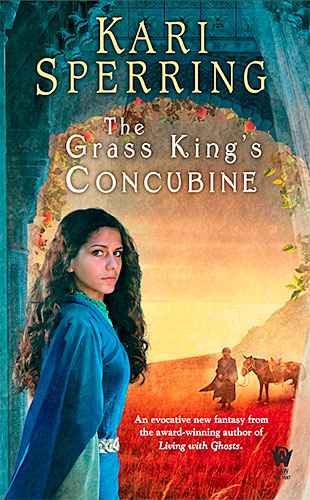
Meanwhile, here’s the beautiful cover, by the very talented Paul Young, and the blurb:

“When a wealthy young woman, obsessed with a childhood vision of a magical Shining Palace, sets out with her true love to search for a legendary land, she discovers the devastated WorldBelow – the realm of the Grass King – and the terrifying Cadre, who take her prisoner, and demand she either restore the king’s concubine… or replace her.”

“In a truly unusual blend of magic
and reality, The Grass King’s Concubine sweeps the reader
from deceptively familiar settings into worlds so rich and strange you
become entranced, hypnotised by the liquid beauty of the writing. Kari
Sperring’s sophisticated, unsentimental style tells a story with a passionate
heart and deep intelligence. Aude is a compelling heroine with a
strong sense of social justice who must unravel the mysteries of
an alien realm, suffused with magic and eeriness. In doing so,
she amazes both herself and the reader in discovering the
interconnectedness of everything. Astonishing, exotic and
profound, this is a journey into the Underworld like none you’ve ever
experienced before.” Freda Warrington, author of Midsummer Night.
“Mixing
machines with magic, The Grass King’s Concubine has an old world Europe
atmosphere wedded to the discovery of the fantastic in a world just
below our own, with changeling ferrets, seas of moss, crystal grass, and
a touch of steampunk.   Readers who love the slow revelations of long-held and long-lost secrets will devour The Grass King’s Concubine.” Joshua Palmatier, author of The Skewed Throne.

Eastercon

It’s Eastercon time again! I shall be off tomorrow: we’re back at the Radisson Edwardian Hotel, Heathrow this year. I’m quite busy on programme this time —

Saturday

12.00 noon ‘Gender Parity on Panels’,
Commonwealth, Paul Cornell, Farah Mendelsohn, Juliet E McKenna, Emma
Peel, Kari Sperring.

7.00
p.m. ‘A History of Feminist SF in Britain’, Room 12: Lesley Hall, Roz
Kaveney, Andy Sawyer, Maureen Kincaid Speller, Kari Sperring.

9.00
p.m. ‘What happens at Milford?’ Room 38: Jacey Bedford, Terry Jackman,
Steve Kilbane, Kari Sperring. A look at the long running professional
writers’ workshop.

11.00 p.m. ‘No Country for Old Men?’ Room 41:
Avedon Carroll, Martin Easterbrook, Dave McCarty, Kari Sperring.

Sunday
4.00
p.m. ‘Subverting the context (alternative universes in fan fiction)’
Room 41: Tanya Brown, Kate Keen, Kari Sperring.

Monday
9.00 p.m. ‘From Fan to
Pro’ Room 38: Paul Cornell, Kari Sperring, Charlie Stross.

I shall hope to see some of you there.

Publication date

I have a publication date for The Grass King’s Concubine — 7th August 2012, just in time for Worldcon. It’s available for pre-order from various places. I am so excited: I’ve lived with this book for almost as long as Living With Ghosts: I began the earliest version of it back in 1995, although it’s changed a lot since then. I love the characters and the setting. It’s in the same world as LWG, but in a different place and set about 150 years later. And while LWG focuses on a city, GKC is set mostly in the world of ghosts and spirits — the variundarii that Gracielis talks about. It has a stubborn heroine, a patient hero, a set of other-worldly warrior-guards and shape-shifting ferret twins. I’ll keep you posted about promotional events, cover details and so on.